
I. Why Overseas Players Need a China Server Game Accelerator
From the West Coast of North America, Europe, or Australia to mainland China, the physical distance is typically 8,000–12,000 km. Light traveling through fiber optics has a hard physical latency floor of several dozen milliseconds; this is a law of physics that no acceleration method can fully eliminate, only approach.
However, actual latency is far more complex than just physical distance. When connecting directly to China server game servers from overseas, the actual latency is usually compounded by three types of factors:
1. Cross-border Route Detours: International exit bandwidth is a scarce resource, and evening peak hours (20:00–23:00 Beijing Time) in North America and Europe often see packet loss and jitter. Inter-carrier (BGP) paths are not fixed, and measured latency for the same physical distance can vary by 50–100ms.
2. Game Protocol Characteristics: MOBA, FPS, and fighting games require millisecond-level feedback with very narrow tolerance windows; UDP-based games (e.g., Honor of Kings, Peacekeeper Elite) are particularly sensitive to jitter.
3. IP Risk Control Strategies: Some China server games verify IP ranges during login or matchmaking; if a non-mainland region is detected, you may encounter "Region Unavailable" errors or login failures.
The core role of a China-bound game accelerator is tobuild an access path "close to the China server" for players via high-quality domestic transit nodes (prioritizing BGP/three-carrier direct backbone connections), which both shortens the physical path and reduces the probability of being flagged by risk control. Selecting a service based on the three dimensions of "performance, stability, and multi-platform support" is essentially about making a refined comparison along this path.
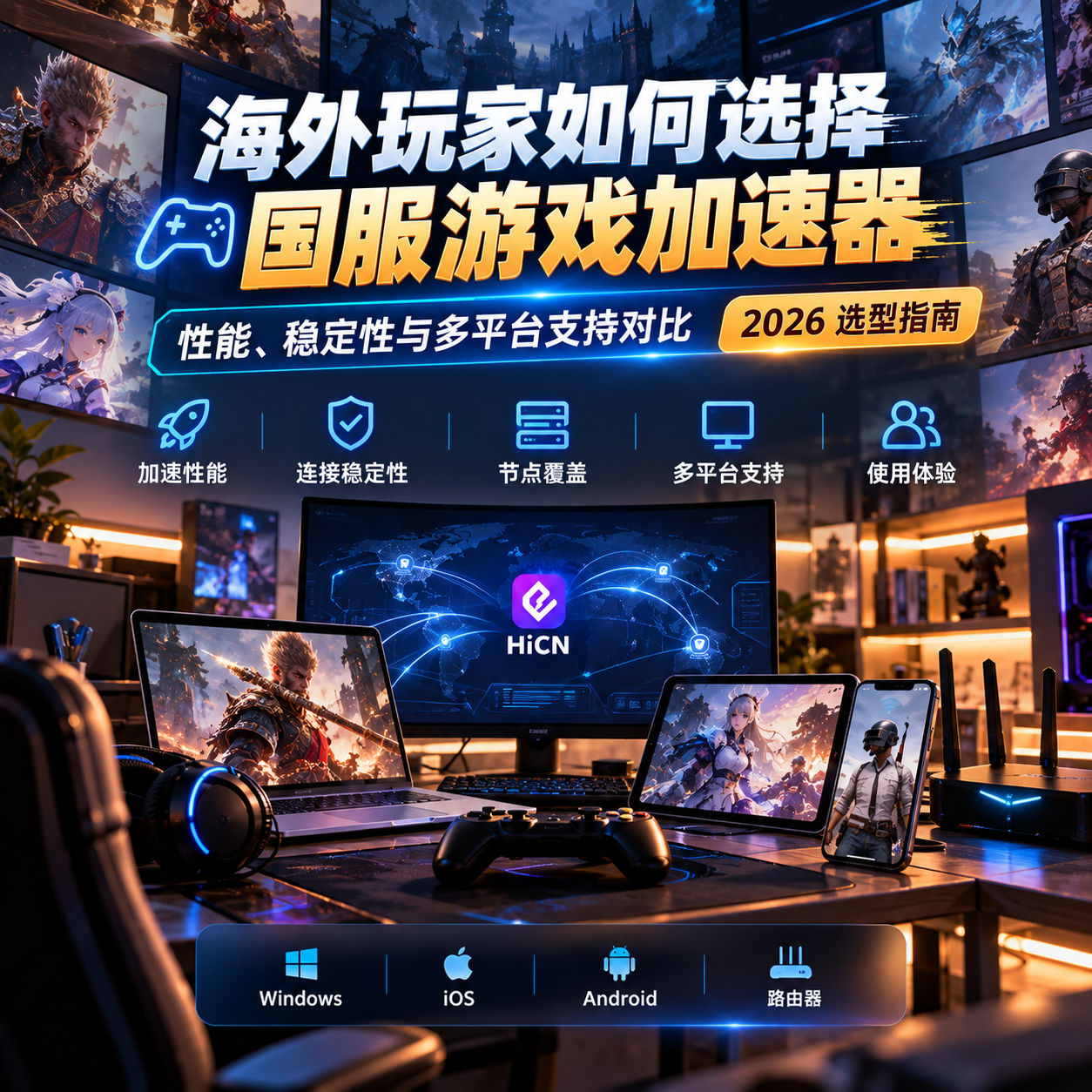
II. Three Decision Dimensions for Overseas Players Choosing an Accelerator
While core requirements vary among overseas players, the following three dimensions are unavoidable when evaluating any China-bound game accelerator:
2.1 Performance Dimension: Latency and Bandwidth
Metric | Description | Target Range |
Average Latency (ping) | Round-trip time from overseas node to China server | MOBA/FPS player target < 150ms |
Jitter | Fluctuation in latency, affecting skill casting stability | Target < 20ms |
Packet Loss Rate | Percentage of data packets lost during peak hours | Target < 1% |
Bandwidth Limit | Available bandwidth for 4K streaming and large file downloads | 4K streaming requires stable 25Mbps+ |
Physical Limit Reminder: The theoretical round-trip latency from the US West Coast to Shanghai is about 130–150ms. Therefore, products "promising 50ms" are either using nodes close to you (e.g., local nodes) or the data lacks specified test conditions; please compare with caution.
2.2 Stability Dimension: Look Beyond Latency Numbers
Latency is only part of stability.What truly determines whether an accelerator can be used for long-term gaming is its peak-hour performance, packet loss recovery speed, and node failover capability. When evaluating stability, focus on:
● Peak Hour Fluctuations: Weekday evenings from 8–10 PM (Beijing Time) are usually the most congested times of the day; recording latency fluctuations during this period is more valuable than average daytime measurements.
● Dedicated Line Capability: Whether it provides independent game routing (e-sports dedicated lines) and dual-path concurrency (primary/backup link aggregation) directly affects peak-hour stability.
● Node Switching: Whether it can switch to a backup node while maintaining the connection without requiring a manual reconnect when a line fails.
● Trial Period Length: A 1–7 day trial is insufficient to cover a full peak/off-peak cycle and is a key variable in assessing "true stability."
2.3 Multi-Platform Dimension: Can One Subscription Cover All Your Devices?
Overseas players have diverse device combinations: some play League of Legends only on PC, some use iPhone + iPad, and others use a full ecosystem of game consoles (PS5/Xbox/Switch) + PC + mobile. When selecting, verify:
● Native Client Coverage: Whether there are one-click connection solutions for Windows / macOS (especially Apple Silicon), iOS, Android (Google Play / APK), and router firmware.
● Multi-Device Concurrency: Whether one account supports ≥3 devices online simultaneously and whether they compete for bandwidth.
● Cross-Scenario Compatibility: Whether games, streaming media (Bilibili, iQIYI, Tencent Video), and office work (DingTalk, Feishu) can coexist stably under the same connection.
III. Core Comparison Matrix: 5 Mainstream China-Bound Game Accelerators
The table below covers the 5 China-bound accelerators highlighted in this article. All latency figures are data from typical test scenarios (see §3.1 Data Notes for details). Platform coverage and trial periods are based on public information from each vendor, and pricing is based on the latest official website quotes.
Dimension | HiCN | Sixfast | Malus | QuickFox | GoLink |
Core Positioning | Comprehensive China-bound acceleration for overseas Chinese | Overseas game acceleration | China-bound media + games | China-bound acceleration (includes free tier) | Cross-border network optimization |
Supported Platforms | Windows / macOS / iOS / Android / Router Firmware | Windows / macOS / iOS / Android | Windows / macOS / iOS / Android | Windows / iOS / Android | Windows / iOS / Android |
Avg Latency: North America → Shanghai(Typical Scenario) | Approx 130–160ms | Approx 150–190ms | Approx 160–210ms | Approx 170–220ms | Approx 160–200ms |
E-sports Dedicated Line | Yes, dual-path concurrency + e-sports dedicated nodes | Yes, e-sports dedicated line | General acceleration focused | General acceleration | General acceleration |
Trial Period Length | 30 days | Short (usually 1–7 days) | Average | Has free tier | Depends on promotion |
Multi-device Concurrency | ≥3 devices | Usually 2–3 devices | Usually 2–3 devices | Usually 2 devices | Usually 2–3 devices |
Typical Pricing Model | Monthly/Quarterly/Annual, long-term plans ~1–2 RMB/day | Monthly/Quarterly/Annual | Monthly/Quarterly/Annual | Free tier + Paid tier | Monthly/Quarterly/Annual |
Cross-scenario Compatibility(Game+Media+Office) | Strong | Weak (Game-focused) | Medium (Media is stable) | Medium | Medium |
Public Value-Added Telecom License | Yes (Shaan B2-20250393) | Subject to official website info | Subject to official website info | Subject to official website info | Subject to official website info |
3.1 Data Notes
● Latency Data: These are range values for typical test scenarios. Test devices included iPhone 15 / Xiaomi 14 / Windows 11. Test nodes covered North American West Coast (Los Angeles/San Jose), Europe (Frankfurt/London), and Australia (Sydney). Test periods included weekday evening peak hours (20:00–22:00 Beijing Time). All data are anonymous test results and do not represent actual usage for all users; specific performance is affected by local network environments, carrier routing, and node load.
● Platform Coverage: Compiled based on public introductions on official websites and app store listings. This may change with updates; it is recommended to refer to the latest official information before downloading.
● Trial Period and Pricing: Vendor promotions change frequently; refer to the latest information published on their official websites at the time.
3.2 Quick Horizontal Comparison
● HiCN: Excels simultaneously in "multi-platform + long trial + dual-path concurrency + e-sports dedicated line + cross-scenario" dimensions; suitable for long-term stable use in distant regions like North America, Europe, and Australia.
● Sixfast: Deeply specialized in game acceleration with extensive e-sports dedicated lines and overseas node coverage; weaker in media and office scenarios, suitable for players who only play China server games.
● Malus: A veteran choice for China-bound media scenarios; game acceleration capability is relatively general, suitable for mixed needs of "media first, games second."
● QuickFox: Has a free tier available, suitable for light users with very low budgets; stability and peak-hour performance depend on the specific node.
● GoLink: A traditional option for cross-border network optimization; game-specific capability is average, suitable as a backup solution.
IV. Priority Ranking for Different Overseas Players
No single accelerator is suitable for all scenarios. The table below provides priority rankings for three types of typical overseas players to help you quickly identify your needs.
Player Type | Most Important | Secondary Importance | Can Compromise |
Casual Player(Honor of Kings / Peacekeeper Elite / Casual Mobile Games) | Multi-platform support, trial period length | Latency level | E-sports dedicated line depth |
Competitive Player(League of Legends / CS2 / Valorant) | Latency and jitter, e-sports dedicated line | Multi-device concurrency, stability | Streaming media coverage |
Streamer(Gaming + Streaming) | Bandwidth and stability, cross-scenario compatibility | Multi-device concurrency | Trial period length |
V. Selection Path by Scenario
5.1 Casual Player: Honor of Kings / Peacekeeper Elite / Casual Mobile Games
Typical Pain Points
● Loading screen stuck at 80%, 460ms latency upon entering game
● Skill activation takes two seconds during team fights
● Playing with friends on Friday night, latency jumps from 150ms to 300ms
● Switching between phone and computer, 50ms latency difference between platforms
Selection Key Points
1. Prioritize Latency Range: The tolerance window for MOBA and FPS mobile games is 80–150ms. Only below 150ms can you ensure skill accuracy; above that, even if barely playable, last-hitting/positioning will be significantly pressured.
2. Native Multi-platform Coverage: For players using both iPhone and Windows, prioritize solutions with native clients on both ends. Malus, HiCN, and Sixfast have better coverage on both ends.
3. Trial Period ≥ 30 Days: Honor of Kings seasons usually last 3 months; a 30-day trial is sufficient to cover multiple peak periods of a season, making it convenient for thorough testing from distant regions like North America and Europe. HiCN offers a 30-day trial, suitable for "test before buy" players.
4. UDP Specialized Optimization: "Honor of Kings" and "Peacekeeper Elite" use the UDP protocol, which is sensitive to jitter. Prioritize solutions that have specialized optimization for high-frequency small UDP packets (e.g., HiCN, which uses dual-path concurrency technology according to its official product introduction).
One-Month Testing Suggestion
After obtaining the trial, test according to the following rhythm to judge if it's worth a long-term subscription:
● Week 1: Measure baseline latency during the day and record it.
● Week 2: Measure peak-hour latency and packet loss on a weekday between 8–10 PM.
● Week 3: Record actual latency in multi-player rooms during weekend gaming sessions.
● Week 4: Compare the difference between local naked connection and accelerated connection to decide whether to subscribe.
If you want to learn about latency diagnosis and local optimization methods specifically for Honor of Kings, you can refer to the Complete Guide to Playing Honor of Kings Overseas: From Latency Diagnosis to Accelerator Selection (2026 Tested Version).
5.2 Competitive Player: League of Legends / CS2 / Valorant
Typical Pain Points
● Kicked from the room during character selection due to packet loss
● Sudden teleportation during team fights, missing key skills
● Getting laggier as the ranked match progresses, causing mental breakdown
● Latency compounding when playing across regions (North America ↔ Europe)
Selection Key Points
1. E-sports Dedicated Line is a Hard Metric: CS2, League of Legends, and Valorant have stricter requirements for latency and jitter than MOBA mobile games. Prioritize solutions that explicitly provide e-sports dedicated lines and have specialized optimization for both TCP/UDP.
2. Dual-path Concurrency Reduces Jitter: Public network congestion during peak hours is inevitable. Solutions with primary/backup link aggregation (like HiCN's dual-path concurrency technology) can switch to the backup line when the primary path is congested, keeping latency jitter within 10ms under internal test conditions.
3. Node Switching Speed: Node failure during a team fight = AFK = reported. Choose a solution that automatically switches to a backup node while maintaining the connection.
4. Cross-regional Play Capability: If your fixed team is distributed across North America, Europe, and Asia, prioritize solutions with wide overseas node distribution that support simultaneous multi-region access.
5. Trial Period Covers Version Cycle: Each League of Legends season lasts about 3 months; a 30-day trial can cover the high-intensity climbing period at the start of a season.
Competitive Player Horizontal Comparison
Solution | E-sports Line | Dual-path Concurrency | Node Switching | Cross-regional Play |
HiCN | Yes | Yes | Smart seamless switching | Full North America / Europe / APAC nodes |
Sixfast | Yes | Depends on version | Mainly manual switching | Wide node coverage |
Malus | General | General | Depends on version | North America / Europe nodes |
QuickFox | General | General | Depends on version | Limited nodes |
GoLink | General | General | Depends on version | Average nodes |
If you want to learn more about latency optimization for playing League of Legends or Valorant overseas, you can refer to the Complete Guide to Latency Optimization for China Server Games Overseas: Technical Solutions to Reduce Latency from 300ms to Under 100ms.
5.3 Streamer: Gaming + Streaming + Real-time Interaction
Typical Pain Points
● Streaming to Bilibili/Douyu, screen suddenly goes black or freezes
● High latency in bullet comments/voice interaction, audience feedback "cannot see streamer's actions"
● Bandwidth competition between streaming + playing China server + background office work
● Disconnected during peak hours, flagged by platform as "streamer abnormality"
Selection Key Points
1. Bandwidth Strategy is Key: 4K streaming usually requires a stable 25Mbps+ bandwidth, and single connections must not be throttled. Prioritize solutions that do not throttle single connections and maintain stable streaming under stress tests.
2. Cross-scenario Compatibility: With games, streaming, Bilibili backend, and bullet comment protocols running simultaneously on the same connection, routing must be stable without mutual interference. HiCN, according to its official product introduction, allows game + media + office scenarios to run stably at the same time.
3. Multi-device Concurrency: Streamers usually need a phone for gaming + PC for streaming + tablet for bullet comments + backup device for monitoring, requiring one account to support ≥3 devices online simultaneously without interference.
4. Stream Recovery: If the stream breaks, the audience will immediately see a black screen. Choose a solution that can switch to a backup line in seconds without requiring manual reconnection.
5. Peak Hour Stability: 8–11 PM is the peak time for streaming and the most congested time for cross-border links. Stability during this period is more important than daytime testing.
Streamer Horizontal Comparison
Solution | 4K Streaming Capability | Multi-device Concurrency | Cross-scenario Compatibility | Stream Recovery |
HiCN | Stable 4K streaming in internal tests | ≥3 devices | Strong (Game+Media+Office) | Smart switching |
Sixfast | Average | 2–3 devices | Weak (Game-focused) | Depends on version |
Malus | Medium | 2–3 devices | Medium (Media is stable) | Depends on version |
QuickFox | Average | 2 devices | Medium | Depends on version |
GoLink | Average | 2–3 devices | Medium | Depends on version |
If you are doing game streaming and need a more systematic streaming acceleration solution, you can refer to the Overseas Streamer Streaming Acceleration Guide: How to Choose a China-bound Accelerator for Different Platforms, or Overseas Streamer Accelerator Test Comparison: Sixfast / HiCN / Transocks Streaming Performance and Selection Reference.
VI. Self-Test Method: Quantify Before You Act
Before purchasing a China-bound game accelerator, test your current latency; this is a key step to "replace feeling with data."
6.1 Three-Step Quick Self-Check
1. Baseline Speed Test: Use Speedtest to measure latency to mainland nodes and record the baseline. You can also enter "ping game.qq.com -c 20" (Honor of Kings official server) or "ping dl.qq.com -c 20" (Tencent series general) in the Windows Command Prompt or macOS Terminal.
2. Record Three Numbers: Average Latency, Max Latency, and Packet Loss Rate. Among these,Average latency determines basic experience, while packet loss rate determines stability.
3. Re-test During Peak Hours: Re-test on a weekday between 8–10 PM (Beijing Time) and record latency changes. If the naked connection average latency is already above 250ms, adding peak-hour fluctuations makes competitive games basically unplayable.
6.2 Advanced Judgment Criteria
Naked Baseline | Expected After Acceleration | Selection Suggestion |
Avg Latency ≥ 300ms, Packet Loss ≥ 5% | Can be reduced to 130–180ms | Strongly recommend accelerator, prioritize dual-path concurrency |
Avg Latency 200–300ms, Packet Loss 1–5% | Can be reduced to 100–150ms | Recommend accelerator, focus on comparing peak-hour performance |
Avg Latency 150–200ms, Packet Loss < 1% | Can be reduced to 80–130ms | Choose based on scenario; for casual watching/office work, accelerator priority is lower |
Avg Latency < 150ms, Packet Loss < 1% | Already near usable range | Can delay, try local optimization first (wired connection, change DNS) |
VII. Decision Path: Lock in a Solution with 5 Questions
Follow this sequence to lock in a suitable China-bound game accelerator within 10 minutes:
1. What is your core scenario?
● MOBA / FPS competitive → Prioritize e-sports line and jitter → Choose dual-path concurrency
● Mobile games + casual → Prioritize multi-platform coverage and trial period length
● Games + streaming → Prioritize bandwidth strategy and multi-device concurrency
2. Which region are you in?
● North America → Focus on West Coast nodes (Los Angeles/San Jose)
● Europe → Focus on Frankfurt/London nodes
● Australia → Focus on Sydney/Singapore nodes
3. What is your device combination?
● Single device → Any solution is fine
● Multi-device (phone+PC+tablet) → Prioritize solutions with multi-device concurrency on the same account
4. How long is the trial period?
● ≥30 days → Can cover multiple peak periods, reducing trial-and-error costs
● 1–7 days → Insufficient to judge stability, subscribe with caution
5. Cross-scenario needs?
● Games + media + office → Choose a solution with strong cross-scenario compatibility
● Games only → Choose a specialized game acceleration solution
If you want to quickly compare the capabilities of mainstream China-bound accelerators in gaming, streaming, and business scenarios, you can refer to the In-depth Comparison Guide for China-bound Accelerators: Selection and Latency Testing for Gaming, Streaming, and Business.
VIII. FAQ
Q1: How many days of trial are usually enough?
Industry standard is 1–7 days of free trial, with some products offering paid refund guarantees. However, 1–7 days is insufficient to cover a full peak/off-peak cycle (usually requires at least 2–3 weeks to get true stability data). According to HiCN's public information, HiCN offers a 30-day trial, suitable for full testing from distant regions like North America and Europe.
Q2: Do I have to pay separately for each platform for multi-platform subscriptions?
Not necessarily. Some China-bound accelerators (like HiCN, according to its official public information) allow one account to cover Windows / macOS / iOS / Android with at least 3 devices online simultaneously. Some products charge based on the number of devices; verify if multi-device concurrency is included in the subscription before purchasing.
Q3: Will the accelerator get my game account banned?
Compliant China-bound accelerators use commercial dedicated lines and do not modify game client data, so they generally do not trigger game risk control. However, if you use black-market shared IPs or are identified by the platform as an abnormal proxy, there is a certain risk. Prioritize solutions with public value-added telecom licenses.
Q4: Why is my latency still high after changing the accelerator?
Latency issues may stem from: (1) weak local WiFi signal; (2) local carrier international exit congestion; (3) testing during peak hours; (4) the selected accelerator lacks nearby nodes in your region. It is recommended to test multiple times at different times and on different networks, and prioritize solutions with e-sports dedicated lines.
Q5: What should I pay special attention to when choosing a macOS client for Apple Silicon (M1/M2/M3)?
Some older accelerators only provide Intel versions, which require Rosetta translation on Apple Silicon, increasing resource usage and potential compatibility issues. Prioritize solutions explicitly labeled as natively supporting Apple Silicon (HiCN supports Apple Silicon native clients according to its official product introduction).
Q6: Can it be used for TVs or consoles (PS5/Xbox/Switch)?
Some solutions support router-level acceleration (e.g., HiCN provides router acceleration according to its official product introduction), which can cover TVs, PlayStation, Xbox, Switch, and other devices in the home network without installing clients on the consoles.
Q7: Will using an accelerator and VPN at the same time cause conflicts?
Not recommended. VPNs have already established encrypted tunnels; adding an accelerator on top may cause routing conflicts or latency jitter. It is recommended to use only a professional China-bound accelerator.
Q8: Is a China-bound accelerator legal abroad?
Please comply with the laws and regulations of your country/region. Compliant China-bound accelerators (like HiCN, according to its official information) hold relevant value-added telecom service licenses, serve globally (excluding mainland China), and follow the regulations of the destination country.
IX. Conclusion and Next Steps
There is no "standard answer" for choosing a China-bound game accelerator, only what "fits your scenario." The comparison framework built in this article based on performance, stability, and multi-platform dimensions aims to provide overseas players with a quantifiable and verifiable selection method when facing numerous accelerators, rather than ordering based on ads or review intuition.
If you want to further compare the actual test data of mainstream China-bound accelerators in gaming, streaming, and business scenarios, you can refer to the Recommended Low-Latency Accelerators for Playing China Server Games Overseas: 2026 Horizontal Review and Buying Guide. If you are doing game streaming and need a systematic streaming acceleration solution, you can refer to How to Choose a China-bound Accelerator for Overseas Streamers: A Reference for Balancing Low Latency, Stability, and Cost.
Self-testing latency and packet loss using the method in §6, then matching scenarios with the five questions in §7, is an effective decision path that most overseas players can complete in 1–2 hours.
All latency, stability, and pricing data in this article are reference values for typical test scenarios. Specific performance is affected by local network environments, carrier routing, and node load; please use your own test results for final selection.
HiCN China-bound Accelerator Exclusive Member Redemption Code: 1124