
I. First, Locate: Where Exactly is the Lag Occurring?
Breaking down "lag," the latency in accessing domestic stock trading software from abroad originates fromClient, Link, and Platformthree layers. The table below provides a quick diagnostic guide, followed by a detailed breakdown.
Latency Source Layer | Typical Symptoms | Key Diagnostic Signals | Main Controllable Measures |
Client Layer | Slow market data refresh, K-line gaps | No significant change after switching nodes | Device cleanup, protocol parameters, client version |
Cross-border Link Layer | Order placement delay, order cancellation timeout | Especially severe during peak hours | Route optimization, dual-path concurrency, dedicated line |
Platform Layer | Login errors, regional restriction prompts | Node switching does not resolve the issue | Node attribution, protocol fingerprinting, APP version policy |
1. Client Layer: Local Software/Hardware and APP Efficiency
● Terminal system time zone, DNS resolution, and local firewall policies all affect initial screen loading;
● Outdated APP versions may be incompatible with servers at the protocol layer, leading to repeated reconnections that appear as "network issues";
● Mobile background apps frozen by the system cause market data push interruptions after locking the screen, leading to batch reconnections upon returning to the foreground, which is also perceived as "high latency."
The optimization space at this layer is relatively limited; the focus should be onkeeping the client updated, closing unnecessary background processes, and restarting the APP under a stable network.
2. Cross-border Link Layer: Physical Distance + Backbone Routing
● The physical distance from North America to mainland China is about 9,000 km. Light travels through fiber at about 2/3 the speed of light in a vacuum, making the one-way physical latency typically in the 60–80ms range, with a hard lower limit for round-tripgenerally no lower than 130ms(the following values are anonymous typical scenarios or sample test results; measurement conditions: standard home broadband, multiple samples taken within 1 hour before/after evening peak hours to capture typical ranges);
● Actual paths often traverse submarine cables + Japan/Korea transit, adding 1.3–1.8 times the detour distance,with measured total latency commonly between 220–380ms;
● The evening peak in Beijing time (20:00–23:00) corresponds to daytime in Europe and America, causing international exit congestion and significantly increased packet loss.
The link layer is the layer withthe most room for optimizationand is where network acceleration services truly play a role.
3. Platform Layer: Regional Identification and Login Risk Control
● Brokerage APPs and market data providers usually identify IP locations; overseas IPs frequently encounter "login failed," "risk warning," or "re-authentication required" issues;
● Market data and trading interfaces may be blocked by server-side risk control rules under abnormal network environments;
● Even after switching client nodes, restrictions may still be triggered due to account or device fingerprinting.
Platform-level restrictionsshould not be blindly treated as "network issues" and adjusted, but should be judged in conjunction with official announcements from the brokerage and the APP.
Measured Latency Reference (No Acceleration Enabled)
Origin | Domestic Market/Trading Service | Direct Connection Latency Range | Typical Symptoms |
North America (West/East Coast) | Tonghuashun/Tongdaxin/East Money | 220–380ms | Order delay, cancellation timeout |
Europe (London/Paris) | Brokerage APP/Market Data | 250–350ms | Slow refresh, login status drops easily |
Australia | Domestic Market Data | 300–450ms | Poor visibility of order receipts |
Southeast Asia (Singapore) | Domestic Market Data | 90–150ms | Usable but significant packet loss during peak hours |
Japan/Korea | Domestic Market Data | 60–100ms | Occasional lag |
Key Conclusion:Users in North America, Europe, and Australia generally need to pay more attention to cross-border link quality, but performance varies greatly by region, ISP, target service, and time. Stock applications are more sensitive toorder receipts and connection continuity, so a single ping value cannot determine if a solution is suitable.
4. Measure Before Optimizing: Don't Just Look at One Ping
Before changing your return-to-China accelerator or node, it is recommended to record at least 3 rounds during non-trading hours, with 5–10 minute intervals, while keeping the device, home network, and target APP fixed. Focus on:
● Median and High RTT Values: Do not just record the lowest ping; higher p95 or occasional spikes better reflect jitter;
● Packet Loss and Reconnection Counts: Brief market data blanks or dropped login states often indicate link stability better than average latency;
● Application Layer Response: Record the time required for login completion, market refresh, page switching, and order receipt visibility. Different APPs have different server processing times, which should not all be attributed to the network.
The latency ranges in this article are foranonymous typical scenarios or sample test references only, not public customer data, nor a service commitment from HiCN to specific users. Actual tests should be based on the user's own region, ISP, device, and target application.
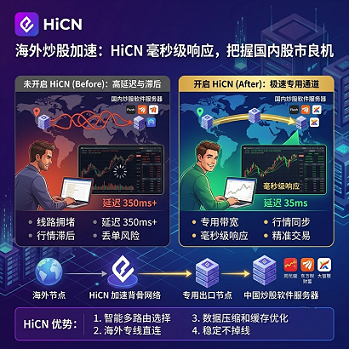
II. How to Choose a Return-to-China Accelerator: Look at Stability First, Then Peak Speed
If you only occasionally check information, a general VPN might suffice; if you need to maintain market connections for long periods, frequently switch pages, or monitor order receipts, you should focus on comparing node load, routing stability, failover, and client control capabilities. The following comparison is for understanding solution differences and does not constitute a ranking or investment advice for any product.
1. Node Overload, Single Path Prone to Congestion
General VPNs usually handle all traffic—gaming, video, office, social—on a few cross-border nodes,which are extremely prone to overload during evening peak hours. The more users on the same node, the less stable the bandwidth per user, which manifests in trading as "fast market data, slow orders" or "signal drops."
2. Lack of Optimization for TCP Long Connections and UDP Heartbeats
Market data pushes often use TCP long connections or high-speed UDP protocols, while order links emphasizeconnection maintenanceandreceipt confirmation. General VPNs often only care if "it can connect" and do not perform congestion control, retransmission strategies, or heartbeat keep-alives for these protocols, resulting in "appearing connected but dropping at critical moments."
3. Node Switching is Not Intelligent, Single Path Interruption Equals Service Interruption
Some tools require users to manually switch nodes,meaning that once the current node is abnormal, the user must discover it and reconnect manually. Even a few seconds of interruption during trading hours can cause users to miss the best order window.
4. Comparison Dimensions with Third-Party Accelerator Solutions
Comparing common solutions on the market reveals their respective boundaries:
Dimension | General Return-to-China VPN | Third-Party "Return-to-China Accelerator" | HiCN Dual-Path Concurrency |
Node Quantity | Few and concentrated | More | More + Dual-Path Concurrency |
Protocol Optimization | General | Gaming/Video-oriented | General + Market/Trading Link Balanced |
Peak Load Capacity | Average | Medium | Dual-path concurrency mitigates single-point congestion |
Intelligent Switching | Mostly manual | Semi-automatic | Backup nodes + Automatic scheduling |
Jitter Control | Average | Medium | Dual-path parallel reduces single-path fluctuation impact |
Important Note: The above comparison is based on public information and typical scenario descriptions,and does not constitute a commitment or ranking for any third-party product. Actual performance will be affected by multiple factors such as network environment, ISP, client version, and regional policies.
Single-Path vs. Dual-Path Concurrency: Principle and Visual Deconstruction
Traditional single-path solutions have only one cross-border channel, and all data relies on this single path:
[Local Client] → [Local ISP] → [Single Cross-border Node] → [Domestic Entry] → [Target Service]
When any segment of this path experiences congestion or packet loss,the entire connection degrades.
The idea behind dual-path concurrency is toenable two independent channels simultaneously, and perform data sharding, parallel transmission, and redundant verification on the client side:
┌─→ [Cross-border Channel A] ─┐
[Local Client] → [HiCN Client] ─→ [Cross-border Channel B] → [Domestic Entry] → [Target Service]
└─→ [Dual-path Aggregation/Redundancy] ─┘
The intuitive benefits are:
● When one channel experiences jitter or instantaneous packet loss, the other channel can still maintain the continuity of market data and instructions;
● The client can dynamically adjust the weights of the two paths based on real-time RTT and packet loss metrics,allowing the better path to carry more traffic;
● During the window of a brief interruption in a single channel,the application layer is less likely to perceive a "disconnection", making it friendlier to order placement and receipt accessibility.
It must be emphasized that: Dual-path concurrency is an engineering approach toreduce single-path risk, andcannot break the lower limit of physical distance. The hard round-trip latency from North America to China is still over 130ms. After combining dual-path and intelligent routing,it can typically fall into the 150–200ms range in anonymous typical scenario sample tests, butdoes not constitute a commitment to any specific user, specific time, or specific service. Actual performance depends on the ISP, local network, target server-side policies, and peak-hour load.
III. Practical Optimization: Measure First, Then Configure, Then Re-test
Users interested in network optimization can continue to delve intoDNS, intelligent routing, and dedicated line hosting. This section breaks down common practices to facilitate comparison with HiCN configurations.
1. DNS Pre-resolution: Reducing Implicit Waiting for Initial Screen and Login Loading
● When the default DNS uses overseas recursive servers, resolving domestic domain names often requires two paths: "Overseas Root → Domestic Authoritative";
● Switching to public DNS closer to China (such as Ali DNS, DNSPod, etc.) for client-side pre-resolutionis significantly helpful forlogin, market data fetching, and initial message push screens;
● Most professional accelerator clients have built-in DNS optimization, which can avoid inconsistencies caused by manual configuration.
2. Intelligent Routing: Selection Logic is More Important than "Whether Acceleration is On"
● The core of intelligent routing isreal-time detection of RTT, packet loss, and available bandwidth, dynamically selecting the optimal path;
● High-quality clients will provide visual information such as node health, current load, and recommended nodes;
● For trading applications, it is recommended toprioritize nodes with stable latency and low jitter, rather than just looking for the node with the lowest ping.
3. Dedicated Line Hosting: The Hierarchy of CN2 / GIA / IPLC
Type | Characteristics | Applicable Scenarios |
CN2 | China Telecom's premium backbone network, independent hosting relative to the public network | Medium-budget return-to-China acceleration |
CN2 GIA | The highest level of CN2, independent AS, low hop count | Latency-sensitive business |
IPLC | International Private Leased Circuit, exclusive physical layer, does not pass through the public network | Finance, cross-border enterprises, trading applications |
HiCN nodes are usually built based on the above backbone resources (specific resources are subject to service provider statements), with dual-path concurrency and backup scheduling overlaid at the routing layer, while maintaining the advantages of dedicated lines andreducing the cost pressure of a single dedicated line.
4. Adjustable Parameters at Client and Protocol Levels
● Enabling QUIC / UDP optimization can reduce initial screen latency caused by TCP three-way handshakes;
● Disable unnecessary proxies and system-level VPNs to avoid routing table confusion caused by multiple overlapping tunnels;
● On mobile devices, turn off low-data modes and "power-saving background freezing" to ensure the survival of long market data connections.
IV. HiCN Configuration Checklist: Placing Dual-Path Concurrency in the Right Place
After applying the previous diagnostic results to the client, HiCN can be verified as a return-to-China acceleration hosting solution. According to official website and help center disclosures, relevant capabilities include dual-path concurrency, intelligent node scheduling, backup node switching, and multi-platform clients. They mainly address the continuity and fluctuation management of cross-border links anddo not replace server-side processing by brokerages or trading platforms, nor do they guarantee trading results.
1. Quick Judgment Before Configuration
Before configuring, use the table below to judge whether you need to "adjust the client" or "change the hosting layer":
Current Symptom | Priority Investigation | Recommended Configuration Focus |
Market data refreshes but order placement is delayed | Link Layer | Switch dual-path nodes, avoid peak hours |
Frequent disconnections during peak hours | Link Layer + Client | Enable backup nodes + client keep-alive |
Can connect but APP prompts "Region Abnormal" | Platform Layer | Consult brokerage/APP customer service |
Only mobile terminal is abnormal | Client Layer | Update APP, turn off power-saving mode |
It must be emphasized again:All performance improvement metrics(such as latency reduction, jitter reduction ratio, etc.)are anonymous typical scenarios or sample test results, and do not constitute a commitment to any specific user, specific environment, or specific time point.
2. HiCN and "Dual-Path Concurrency" Capabilities in Practice
Applying the layered optimization ideas from Section 3 to specific clients, HiCN mainly provides the following capabilities at thelink hosting layer(subject to official page and help center disclosures):
● High-Speed Dual-Path Concurrency: If the current client and node provide this capability, two cross-border channels can be used simultaneously to transmit data; when one channel experiences jitter, the other may help maintain connection continuity;
● Intelligent Node Scheduling: Based on real-time latency, packet loss, and other metrics, it assists in selecting more suitable nodes, reducing the cost of relying entirely on manual trial and error;
● Backup Nodes and Switching: Attempts to switch to backup nodes when the main node is abnormal, reducing the impact of single-path interruptions on connections;
● Multi-platform Coverage: Official data shows support for Windows, iOS, Android, etc. Specific platforms, versions, and concurrent online rules are subject to the latest pages and plan descriptions.
3. Initial Configuration Steps (Recommended Process)
1. Download and Installation
● Go to the Android client QR code to download the corresponding platform client;
● For mobile devices, if you need to install an APP, prioritize obtaining it through the App Store / Google Play portals provided on the official page to avoid using third-party distribution versions of unknown origin.
2. Login and Node Selection
● After registering and logging in, enter the "Return-to-China Acceleration" or "General Acceleration" list;
● If the current version provides a "Dual-Path" label, you can use it as a test candidate while observing node health, RTT, and packet loss.
3. Acceleration Mode Selection
● For stock applications, it is recommended to select "General/Office" or "Financial" modes (if available) to avoid unnecessary routing changes caused by mistakenly selecting "Gaming Priority" mode;
● If the client provides a DNS optimization switch, it is recommended tokeep it enabled.
4. Verify Connection Quality
● Open APPs like Tonghuashun/Tongdaxin/East Money and observemarket refresh speed, login status retention time, and order receipt delay;
● You can switch between different nodes during trading hours to compare and find the most stable node for the current period.
5. Multi-device Collaboration
● Whether the same account supports simultaneous online access on PC, mobile, or tablet is subject to the current plan and official instructions;
● When performing trading verification, it is recommended to fix one device as the main link first to reduce variables such as multi-device login, network switching, and account risk control.
4. Optimization Suggestions for Typical Scenarios
● North America (West/East Coast) for Day Trading
○ Choose "Dual-Path" nodes with stable latency and low jitter;
○ Pay attention to the peak period of 20:00–23:00 Beijing time; manually confirm backup node accessibility if necessary.
● Europe (London/Paris) for Long-term/IPO Subscription
○ Login status retention and message push are priorities; it is recommended to enable the "Long Connection Keep-Alive" switch (if provided by the client);
○ On mobile devices, it is recommended to turn off power-saving mode to avoid market data pushes being frozen by the system.
● Australia/New Zealand Focus on Morning Market
○ The Shanghai/Shenzhen morning market 09:30–11:30 corresponds to 11:30–13:30 Australian time;start acceleration and login 15–30 minutes in advance, to avoid handshaking seconds before the market opens;
○ You can use the client's "Start on Boot + Auto-connect" to reduce human error.
V. Troubleshooting and Compliant Use
1. Emergency Troubleshooting and Pitfall Tips
● Nodes All Red / All Timed Out
○ Check if the local network is normal;
○ Switch to other node families, or try logging out and logging back into the client;
○ If it still doesn't work, wait 5–10 minutes (avoiding ISP maintenance windows) and try again.
● Can Connect but Market Data is Significantly Laggy
○ Prioritize switching nodes rather than repeatedly toggling the client;
○ Clear DNS cache in client "Settings," close redundant proxies;
○ Check if the APP has a new version; some latency issues stem from mismatches between client and server protocols.
● Login Prompts "Region Abnormal" or Risk Control Interception
○ This is usually aplatform-level issueand does not fall within the scope of what network optimization can solve;
○ It is recommended to contact the brokerage or APP customer service first to confirm regional login policies, then decide if you need to change node attribution.
● Avoid "Major Adjustments" to the Network Environment During Trading Hours
○ Such as switching home Wi-Fi, changing routers, adjusting system proxies, etc.;
○ It is recommended to complete these during non-trading hours and keep the verified stable configuration for trading days.
2. Compliance and Risk Warning
● Cross-border Access and Financial Compliance: Different countries have different compliance requirements for accessing domestic financial systems and brokerage APPs from abroad. Please be sure to comply with the regulatory requirements of the country or region where you are located;
● Brokerage Agreements: Before using an accelerator to access brokerage APPs, please read the relevant brokerage's user agreement and latest announcements to avoid violating platform rules and causing account risks;
● Network Optimization ≠ Investment Advice: All content in this article focuses only onnetwork latency and connection stabilityand does not constitute a recommendation for any specific stock, strategy, brokerage, or trading timing.
VI. FAQ: Common Questions About Accessing Domestic Stock Software from Abroad
Q1: Is a general VPN enough?Not necessarily. General VPNs mainly solve "whether it can connect," but stock applications have higher requirements forlong connection stability, jitter control, and continuous node availability. Solutions that are single-path, node-concentrated, and lack intelligent switching are prone to issues during trading hours.
Q2: Does dual-path concurrency guarantee lower latency?No. The core value of dual-path concurrency is toreduce the impact of single-path jitter and instantaneous packet loss on business. Under the premise that physical distance and ISP routing conditions remain unchanged,total latency will not break the physical lower limit. Its advantage is reflected in being "more stable," not "absolutely faster."
Q3: What if I turn on the accelerator and the APP still prompts "Region Abnormal"?This belongs to platform-level risk control. Prioritize confirming the brokerage APP's current regional login policy, then consider switching node attribution, clearing device fingerprints, or contacting customer service. Do not attribute all such issues to network problems and repeatedly adjust settings.
Q4: Can HiCN guarantee stability below a specific latency value? No. No cross-border network service can guarantee specific latency values for all users at all times in all regions. HiCN's dual-path concurrency, intelligent scheduling, and backup node designaim to reduce the probability of significant jitter and disconnections in typical scenarios, and actual performance still depends on the local network, ISP, target service, and time period.
Q5: Can I try HiCN for free? Yes,HiCN return-to-China accelerator exclusive member redemption code: 1124, can be used for a 7-day trial.
Q6: What should I do first if I find market data lag during trading hours?It is recommended to troubleshoot in the order of "Switch nodes → Check client version → Switch network (Wi-Fi/Wired/Mobile Network) → Contact brokerage/APP customer service."Do not make large-scale network environment changes during trading hours.
Q7: Does dual-path concurrency significantly increase traffic or costs?The total traffic of dual-path concurrency will be slightly higher than single-path, but it is usually within the carrying capacity of the user's plan.Whether a specific plan includes unlimited traffic or restricts nodes or functions is subject to the current plan description on the HiCN official website, do not equate marketing page promotions with default rights.
VII. Conclusion: Do Network Verification Well, Then Leave Decisions to Yourself
Accessing domestic stock software from abroad first solves the availability and observability of the connection, not the trading itself. Following the order of "Locate problem → Select hosting → Configure nodes → Apply re-test → Retain backup plan" is usually easier to find settings suitable for yourself than repeatedly changing tools.
Returning to the practical path of the full text: first use the "Client / Link / Platform" three-layer diagnostic table to locate the main bottleneck, then select layered means such as DNS pre-resolution, intelligent routing, dual-path concurrency, or dedicated line hosting according to the scenario, and finally use a hosting layer that can providedual-path concurrency + backup nodes + intelligent scheduling(such as HiCN) for actual verification, which is a relatively stable path for current overseas stock traders.
If you are comparing return-to-China accelerators, it is recommended to first check the Android client QR code for current platform support, node descriptions, and trial policies, and perform small-scale verification with your own devices and target APPs during non-trading hours before deciding whether to include it in daily use.
This article does not constitute investment advice. Please comply with local financial regulatory requirements, brokerage agreements, and relevant platform rules for cross-border access; network optimization can only improve connection conditions and cannot guarantee market data, orders, transactions, or investment results.