
1. The Real Starting Point for Selection: Your Live Streaming Setup, Not the Service Provider's Official Website
The most common pitfall when choosing a China return accelerator islooking at the product list before defining your own needs. Reversing this order will drastically reduce your decision-making costs: put your live streaming scenario down on paper first, then match it against the solutions.
Write down these three questions:
1. What do you mainly stream?—Competitive games like FPS / MOBA (where every 16ms affects gameplay), or e-commerce streaming/video conferencing (where 50–100ms is acceptable)?
2. Where is your location of departure?—The physical baseline differences between North America, Europe, Australia, East Asia, and Southeast Asia are on the magnitude of 100ms.
3. Is your scenario temporary or long-term?—A single tournament, a single business trip, a month-long trip, or long-term business residency require different subscription strategies.
If even one of these three answers is vague, don't place an order yet. The following three sections will help you define your answers specifically.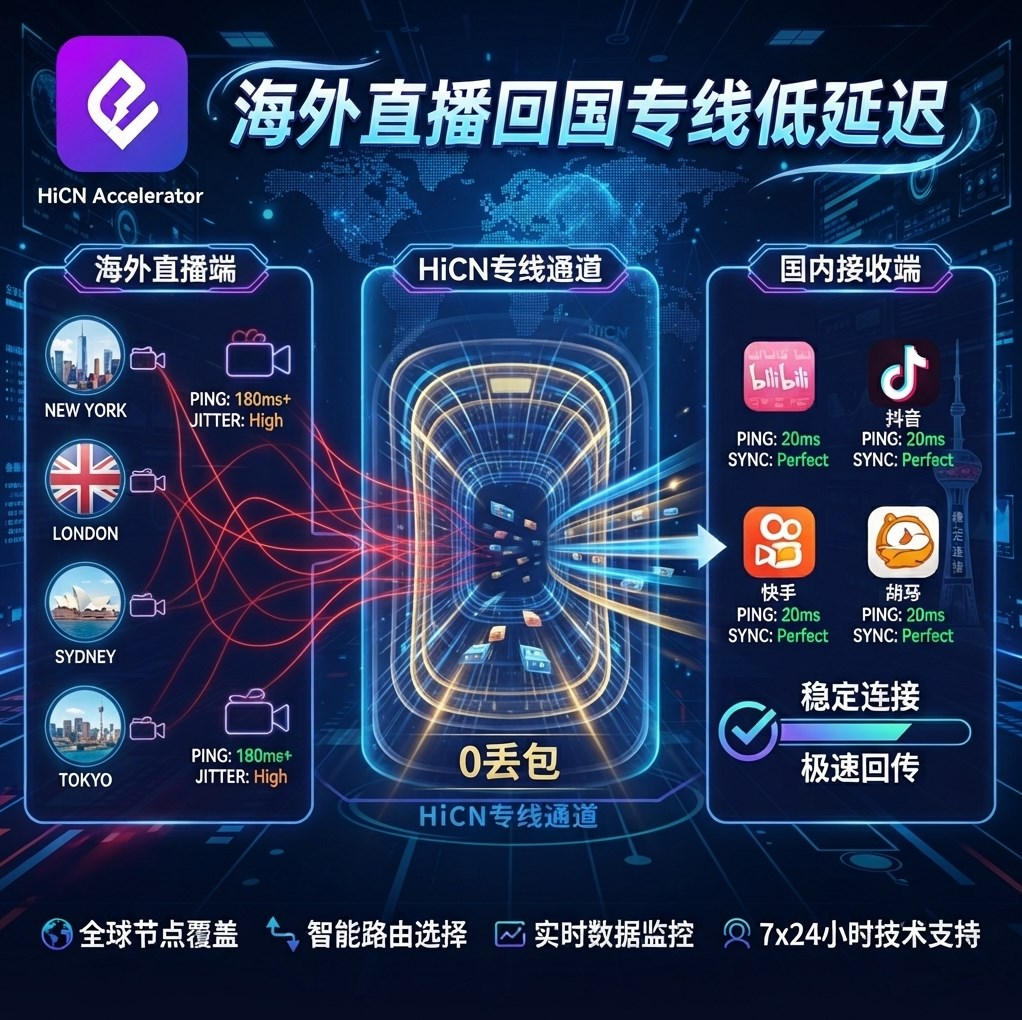
2. Three Truths About Cross-Border Dedicated Lines (Common Sense Beyond Marketing Jargon)
Regardless of which accelerator you choose, the following three facts will not change:
1. Physical distance sets a hard lower limit. From North America to Mainland China, the one-way distance is between 10,000–11,500 km. The physical latency of light traveling through fiber for this distance alone is about 50ms one-way and 100ms round-trip (RTT). No solution can eliminate this baseline; all they can do iskeep the average close to the baseline and minimize fluctuations.
2. The evening peak hour is the real test. Many solutions yield a pretty figure of 130ms when tested at 6:00 AM, but jump to 280ms+ at 9:00 PM. Fix your testing time tothe actual hours you will be live streaming, in order to get meaningful comparative data.
3. Free tiers have a clear ceiling. Free tiers usually limit bandwidth and duration; for long-duration commercial streaming, please use a paid plan. Free tiers are suitable for initial trial and short, low-intensity usage, but not as your primary option.
3. A Self-Test Method for Latency/Packet Loss You Can Run Yourself
Selection should not rely on screenshots. The following workflow can be reproduced during any provider's free trial period:
Step 1: Three time slots, three destinations. Ping your target platform (Chinese server game server or Bilibili streaming ingest point) at 8 AM, 2 PM, and 9 PM respectively, recording the RTT and packet loss rate. The worst result among the three reflects your real 'daily experience'.
Step 2: 30-minute long stream testing. Use OBS/Streamlabs to push an unloaded stream for over 30 minutes (using standard settings like 1080p 30fps), observing bitrate stability, dropped frames, and disconnect frequency. These are key metrics that a single ping cannot reveal.
Step 3: Multi-device/multi-platform comparison. At the same time, connect a PC, mobile phone, and router to the same solution to check if end-to-end streaming latency is consistent. If the difference exceeds 50ms, it indicates routing discrepancies across client devices.
Step 4: Switch nodes and re-test. With the same service provider, switch between 2–3 different nodes (e.g., Japan, Singapore, US West Coast) and compare peak-hour performance. This tells you if the provider's operational maintenance quality across different nodes is balanced.
Once you finish these four steps, the real performance of the solution will be clear, and marketing buzzwords will no longer mislead you.
4. Further Breakdown of the Four-Dimensional Evaluation Framework
In this industry, 'low latency, high stability, unlimited data' are often touted together, but they cannot all achieve extreme values simultaneously. Breaking down the four dimensions helps prevent you from being swayed by 'wanting it all'.
Dimension 1: Ping volatility and packet loss distribution. Focus on jitter (ping fluctuation range) and packet loss rate, rather than average latency. A connection with an average of 180ms and ±5ms jitter is far more stable than one with an average of 130ms and ±40ms jitter.
Dimension 2: Routing strategy. Single line, dual-path concurrence, dynamic routing, edge nodes—these terms refer to different technical implementations.Dual-path concurrence (such as HiCN's publicly claimed simultaneous transmission over dual lines) has the most noticeable effect on reducing jitter in gaming live streams;dynamic routing (such as edge nodes emphasized by Malus) is better suited for multi-platform switching.
Dimension 3: Node geography and platform coverage. Having many nodes doesn't mean good coverage—you need to look at whetherthe local access point in your location of departureandthe exit node required by your target platform (Chinese game server, Bilibili, Douyin Live)are both present. Australian users should especially beware of cases where 'Asia-Pacific nodes' and 'Australia nodes' share the exact same servers.
Dimension 4: Subscription models and trial duration. Beyond monthly fees, the length of the trial period determines your actual decision cycle. A single tournament requires a one-week trial, while a full season might require a month; a solution with a trial long enough for you to complete a full tournament schedule lets you 'learn through real competition'.
5. Quick Overview of Positioning for HiCN, Sixfast, Malus, and QuickFox
The following overview is mainly based on the positioning publicly disclosed on the official websites of the four providers, without endorsing any single one. For specific trial duration, node counts, and monthly fees, please refer to their official pages when ordering.
HiCN (hicn01.com)—Focuses on 'dual-path concurrence + esports dedicated lines + trial periods longer than the industry average', and provides specialized optimization for Honor of Kings / Game for Peace Chinese servers in Supported Games - HiCN Return Accelerator . In terms of form factor, besides Windows/iOS/Android/Google Play clients, it also offers hardware like HiCN Return Accelerator Box , making it suitable for families or small teams to share dedicated lines.
Sixfast (Sixfast Accelerator Official Website - Overseas Chinese Accelerator to Return to China | Return Accelerator | One-Click Acceleration for Chinese Games, Videos, Music, and Applications)—An overseas Chinese return accelerator whose positioning emphasizes stable overseas streaming and gaming lines. The key to judging whether it's suitable is whether its nodes cover both your location of departure and your streaming target platform.
Malus (getmalus.com)—Emphasizes dynamic routing and edge nodes, aiming to reduce latency through user-adjacent access points and real-time path selection.When comparing against it, differences often manifest in the stability of streaming frame rates, rather than a single ping figure.
QuickFox (One-Click Accelerator to Return to China for Overseas Chinese - Quick Fox)—Offers both free and paid tiers, with the free tier available long-term. Short-term trial users or lightweight video watchers can start here; for long-duration high-bitrate streaming, upgrading to a paid tier or switching to other solutions is recommended.
How to Read This Section: The four providers have different positionings rather than a ranked order. For example, if you care most about dual-path concurrence and failover, look at HiCN first; if you care most about a free tier, look at QuickFox first. Ask yourself what matters most before making a horizontal benchmark.
5.5 Quick Reference Table: Common Needs vs. Recommended Direction
If the comparison above still feels abstract, the following quick reference table compresses 'Scenario — Focus Dimension — Mainstream Direction' into single lines:
Your Primary Situation | Priority Focus Dimension | Mainstream Direction |
FPS / MOBA streaming in North America | Dual-path concurrence, jitter, instant node switching | Prioritize routing layer reliability |
Business streaming or video conferencing in Western Europe | Instant failover, evening peak-hour jitter | Choose solutions with stable Western Europe exits during peak hours |
Long-duration streaming in Australia | Independent Australia exit, evening peak-hour jitter | Beware of shared nodes between 'Asia-Pacific' and 'Australia' |
Temporary business trip / show watching / light usage | Trial duration, free tier | Start with solutions that include a free tier |
Long-term cross-border team office work | Device limit, cross-region billing, auto-renewal terms | Multi-year subscription + backup plan double insurance |
The table above merely compresses the contents of Sections 3 to 5 into a quick reference version.Each row needs to be verified using the testing methodology in Section 3, before deciding on a specific solution. In most cases, the 'Mainstream Direction' in the rows only guides you to which comparison column to look at, rather than giving a single direct answer.
6. Recommended Paths by Region and Scenario
Below, 'Region × Platform × Content' is expanded into an actionable lookup table. Please treat it as a self-check checklist, not a shortcut answer key.
North America (US/Canada) → Mainland China
● The physical baseline from North America to Mainland China is in the 150–220ms range, making it the longest distance among the four regions.
● FPS/MOBA Live Streaming: Extremely sensitive to packet loss; prioritize whether the routing layer supports dual-path concurrence. See High Latency and Lag Playing Game for Peace Chinese Server Emulator Overseas? HiCN Overseas Return Accelerator Recommended. and High Latency and Lag Playing League of Legends Chinese Server Overseas? HiCN Overseas Return Accelerator Recommended. in Gaming News - HiCN Return Accelerator for specific latency data as a comparative reference.
● E-commerce Streaming / Video Conferencing: Higher tolerance for latency fluctuation than gaming, but requires zero disconnects over long periods; annual plans offer better monthly value.
● Bilibili / Douyin Recorded Video Uploads: Lowest real-time latency requirement; you can start with a solution that offers a free tier to test the process.
Western Europe (UK/Germany/France/Spain) → Mainland China
● The baseline is in the 170–210ms range; the physical minimum is slightly better than North America, but still significant.
● The key focus is not lowering the average latency, but controlling evening peak-hour fluctuations. Look for the provider's instant failover capabilities during outages.
● Regular needs of small cross-border e-commerce teams (live audio connection, internal ERP) usually require long-term stable lines; trial length equals your decision-making window.
Australia (Sydney/Melbourne) → Mainland China
● Australia's baseline of 130–170ms seems better than North America's, but the number of nodes is limited—many service providers group Australia under 'Asia-Pacific' using shared servers, causing noticeable peak-hour jitter. Make sure to confirm that the provider has independent exit nodes in Sydney/Melbourne.
● High-bandwidth, long-duration scenarios (such as Unable to Watch Chinese Live Stream of World Cup 2026? Complete Match Watching Guide for Overseas Users ) indirectly reflect the service provider's stability under high load.
East Asia / Southeast Asia (Hong Kong/Japan/Korea/Singapore) → Mainland China
● This is the optimal latency range (50–120ms), where all four providers perform well in the Asia-Pacific region.
● What users in this tier care most about is actually cost performance. Asia-Pacific subscriptions are usually cheaper than North America / Europe dedicated lines; whether it's sufficient depends on whether your daily network path is truly cross-border.
7. What a Trial Period Can and Cannot Verify
During the trial period, it CAN verify:
● Ease of client installation and login
● Basic connectivity with your target platform
● Latency and packet loss performance across morning, afternoon, and evening time slots
● Stability of 30-minute long streams
During the trial period, it CANNOT reliably verify:
● Stability degradation after 6 months or a year of long-term use
● Emergency response capabilities during sudden major node outages (which may happen only once or twice a year)
● True response speeds of customer service and support tickets
● Hidden clauses in auto-renewal fine print (many terms are only revealed upon the second charge)
Therefore: After finishing the trial and concluding that it is 'basically usable', do not skip verifying long-term terms and conditions. This is actually the step users omit most frequently.
8. Three Details You Must Check Before Signing Up
Detail 1: Auto-renewal policy. Many subscriptions enable auto-renewal by default. The most common complaint among overseas Chinese is 'forgetting to cancel and being charged for a full year'. Turn off auto-renewal in your account settings immediately after completing your order, and set a calendar reminder for the expiration date.
Detail 2: Device limit. Some solutions limit the number of simultaneous online devices; counting phone + computer + router , whether you remain within quota determines if you need to pay extra for additional devices.
Detail 3: Cross-region billing. Some solutions charge separately by 'regional nodes', such as having distinct tiers for US, Europe, and Asia regions. If you move across regions frequently, confirm whether switching nodes requires a new subscription.
9. After Selection: Practical Way to Keep a 'Backup Option'
No solution can guarantee 100% uptime, especially for major tournaments or commercial live broadcasts.Keeping a low-cost backup option is the simplest and most practical approach:
● Choose your most trusted provider for your primary plan (use a paid tier)
● On another device, install an entry-level or free tier as a backup
● If your primary plan fails, you can switch the stream to the backup within 30 seconds
The backup does not need to achieve 100% of the primary plan's performance; it only needs to get you 'barely operational', avoiding reputation loss caused by stream drops mid-broadcast.
10. Next Steps
● To understand specific capabilities from the gaming end, please see Supported Games - HiCN Return Accelerator; to learn about router form factors, please see HiCN Return Accelerator Box.
● To compare recent content on the same topic, please see Gaming News - HiCN Return Accelerator. Within the same series, How to Choose a Low-Latency Accelerator for Game for Peace Chinese Server Overseas: A Complete Guide from Ping Values, Stability to Multi-Device Coverage (2026 Buying Guide Edition), 2026 Overseas Honor of Kings Return Accelerator Guide: Latency Map and Tier Comparison Across US, UK, Australia, and Japan, Analysis of Root Causes for High Honor of Kings Latency Overseas and HiCN One-Click Optimization Path, and Soda Music Overseas Regional Restriction Accelerator Selection Decision Guide (2026 Tested Edition) are extended applications of the same methodology.
Closing Remarks: Selecting a return dedicated line has no 'get it right once, set forever' solution. Once you fix your 'Region × Platform × Content', re-test every six months using the methodology above—providers, nodes, and carrier routings are constantly changing; periodic re-testing is more reliable than a one-time decision.
HiCN Return Accelerator Exclusive VIP Redemption Code: 1124